
What are you looking for?
Explore our services and discover how we can help you achieve your goals

Explore our services and discover how we can help you achieve your goals
Digital Transformation | HR Technology | HRM Solution | Workforce Automation
Work with this team
/02 Product tour
/03 Before
Manual job scheduling consumed countless administrative hours. Spreadsheets tracked technician availability inconsistently. Dispatch decisions relied on guesswork rather than skill matching. Double-bookings occurred regularly. Technician idle time increased due to poor route planning. Customer response times suffered as a result. The company couldn't scale service capacity without proportional administrative overhead growth.
Managers lacked real-time insight into ongoing jobs. Technician locations remained unknown. Customer status questions went unanswered because nobody knew actual job progress. Performance problems festered undetected. Bottlenecks persisted without visibility into root causes. Decision-making relied on incomplete information and intuition rather than operational reality.
Customers waited without knowing service status. Appointment reminders didn't exist, generating no-shows. Service history remained inaccessible during follow-up calls. Communication happened sporadically through multiple channels. Maintenance opportunities were missed because systems didn't prompt timely follow-ups. Customer relationships depended entirely on individual technician rapport rather than systematic engagement.
Parts and materials scattered across multiple locations without centralised tracking. Stockouts occurred unexpectedly, delaying service completion. Overstocking tied up cash without improving service delivery. Tools disappeared regularly without accountability systems. Purchasing decisions relied on memory and intuition rather than data analysis. Profitability suffered from inventory waste and inefficiency.
Invoice generation consumed significant administrative time. Payment collection delays extended cash conversion cycles. No reminders prompted timely payment, extending receivables. Financial visibility into profitability by service, technician, or customer remained impossible. Cash flow suffered from inefficient billing processes. Financial reporting required extensive manual compilation.
Leadership made growth and resource decisions without supporting data. Service profitability remained unknown. Technician productivity metrics didn't exist. Customer satisfaction levels couldn't be measured reliably. Strategic planning relied on assumptions rather than evidence. Opportunities for improvement remained hidden within operational chaos.
/04 After
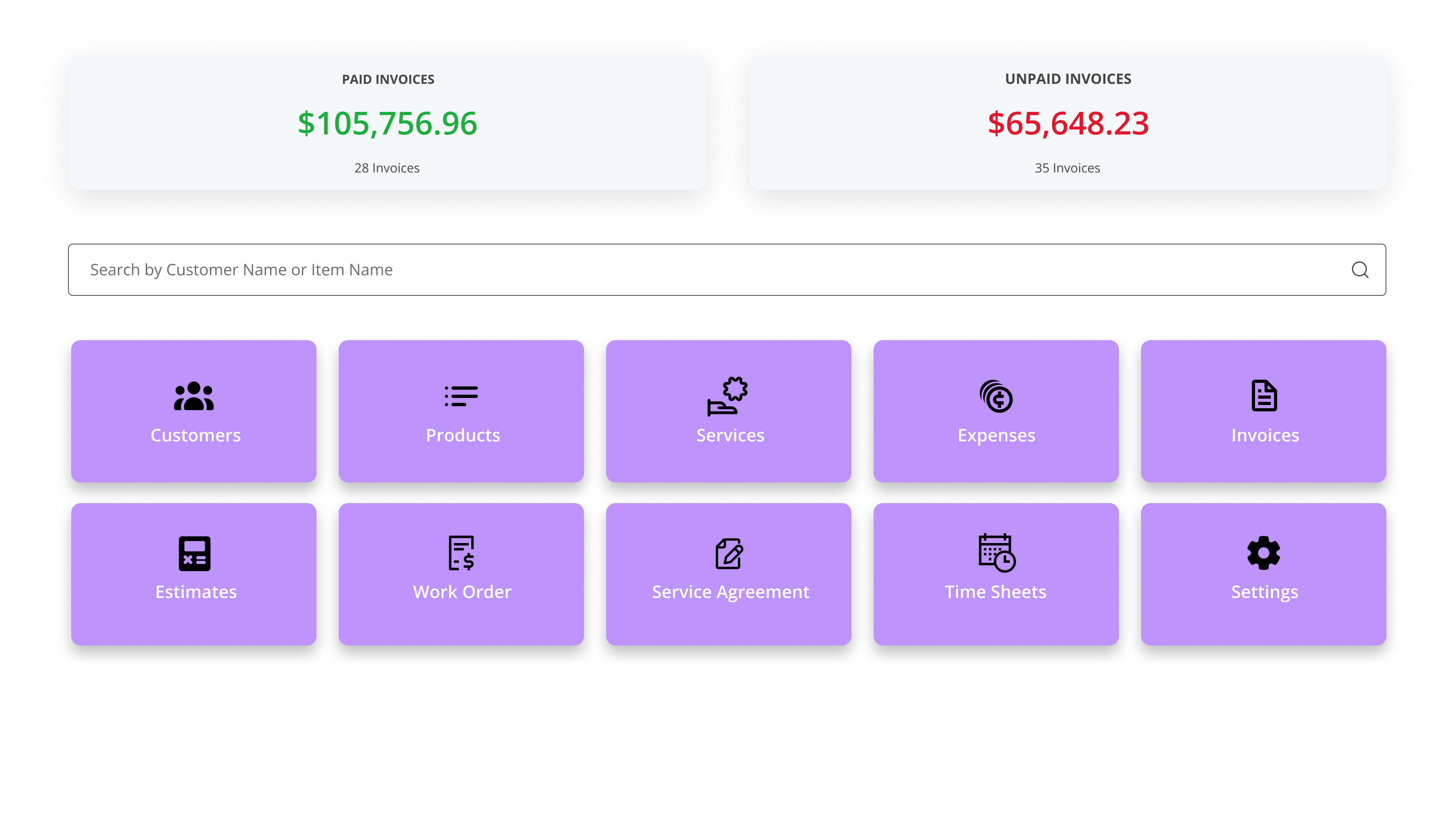
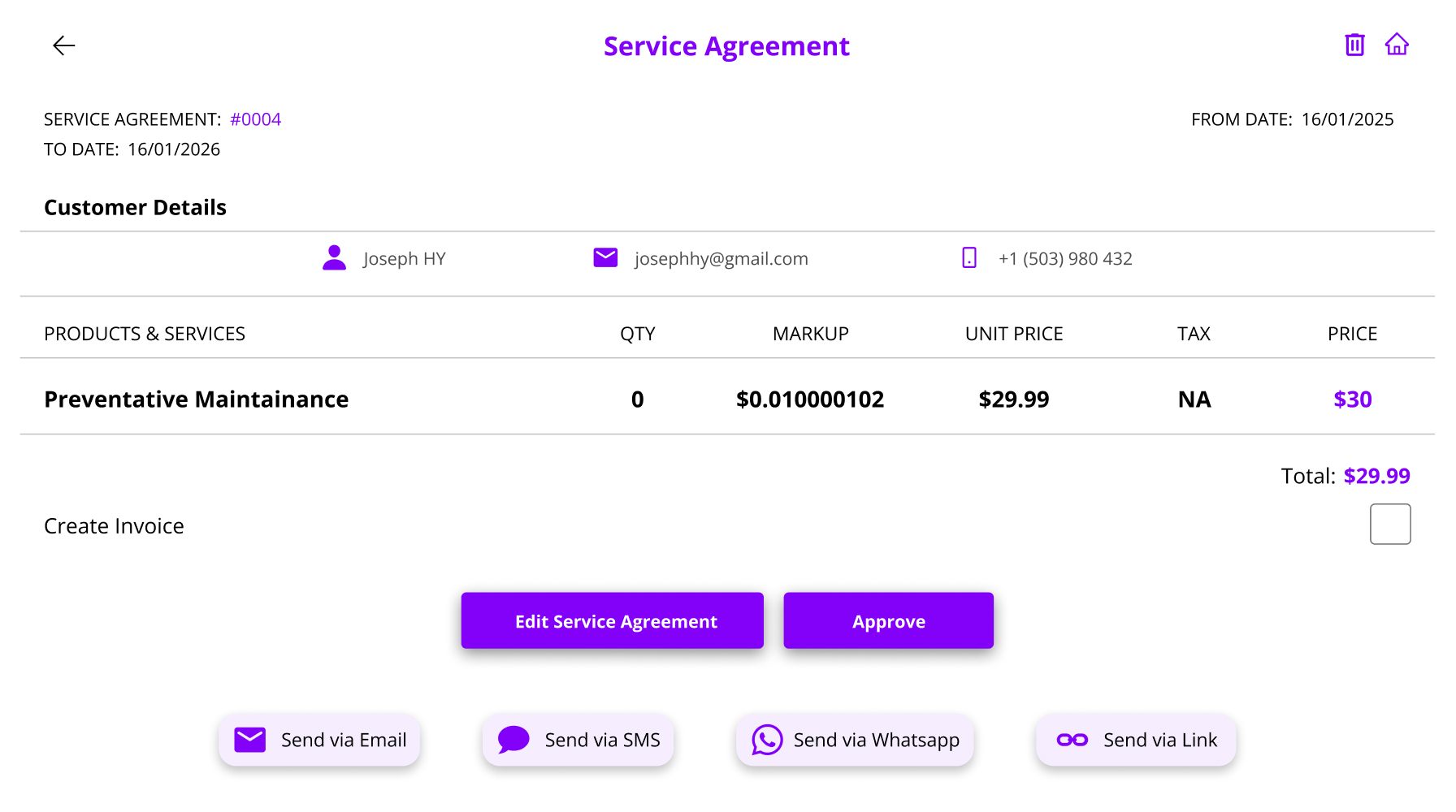
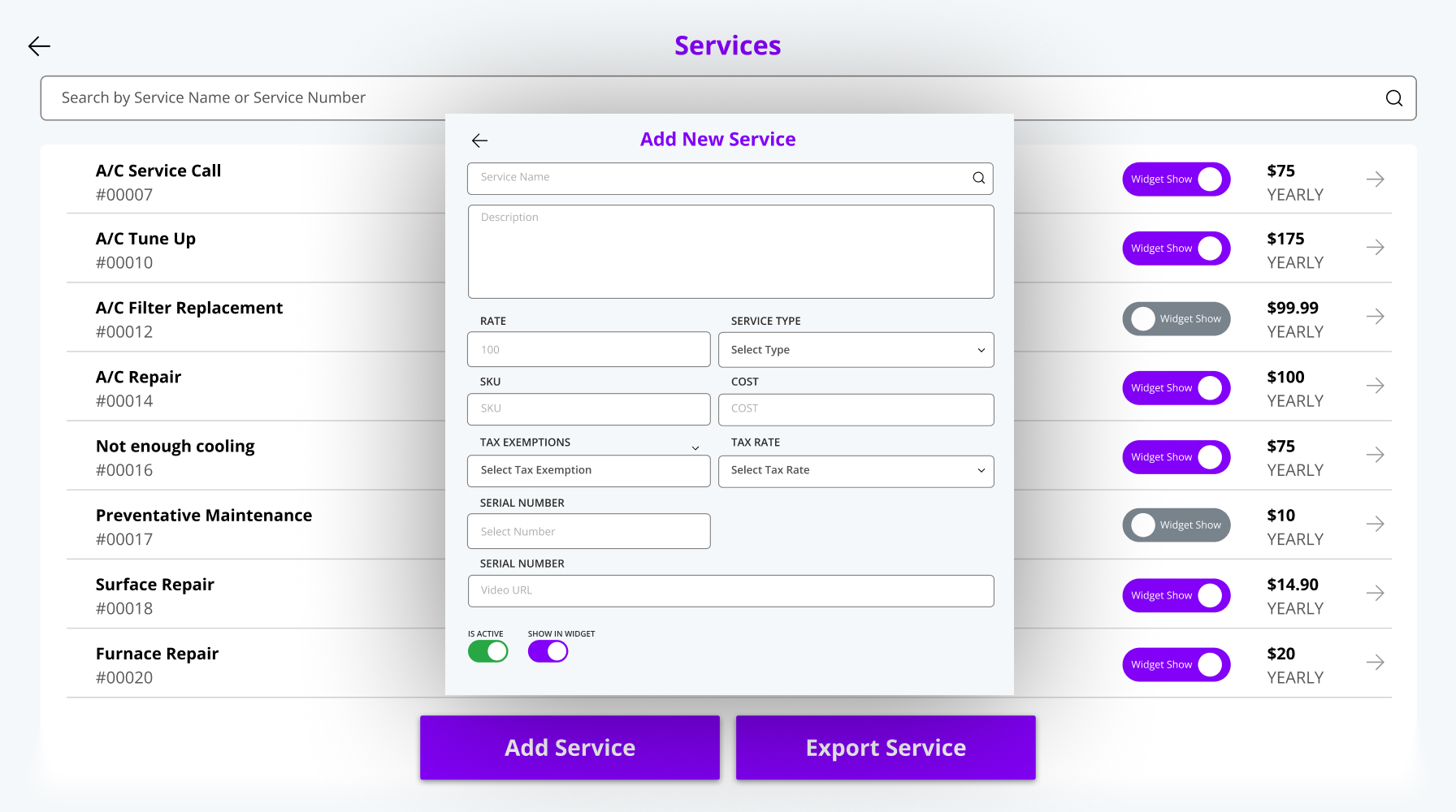
We engineered a comprehensive HVAC management platform consolidating all business operations into one accessible, intelligent system. Cloud-based architecture enables management from anywhere—headquarters, home office, or mobile. Automatic synchronisation keeps all data current and consistent across teams. Intelligent automation eliminates manual drudgery. Real-time visibility replaces guesswork. Data analytics reveal continuous improvement opportunities.
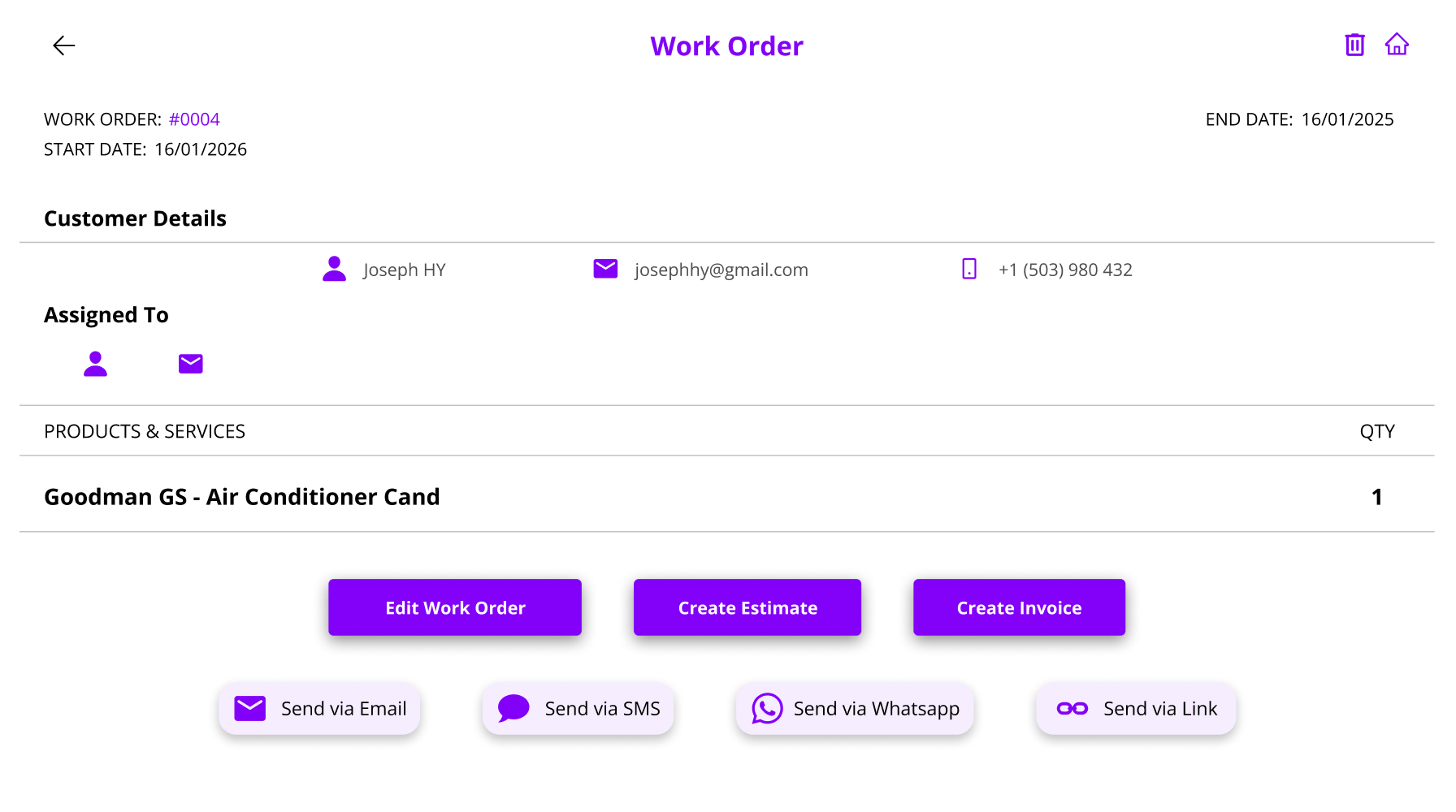
Automated algorithms match technician skills to job requirements intelligently. Route optimisation reduces travel time and costs substantially. Real-time capacity visibility prevents scheduling errors. The system automatically assigns jobs to the most appropriate technician based on proximity, capability, and current workload. Double-bookings disappear entirely. Technician utilisation improves. Response times accelerate. Customer satisfaction improves immediately.
GPS tracking shows technician locations constantly. Job status updates in real-time as work progresses. Managers identify bottlenecks immediately rather than discovering them retrospectively. Customers receive proactive status notifications rather than wondering about service progress. Resource allocation happens intelligently based on actual conditions rather than assumptions. Issue escalation occurs immediately upon detection rather than festering silently.
Appointment reminders reduce no-shows dramatically. Maintenance alerts prompt timely service scheduling. Status updates keep customers informed throughout service delivery. Follow-up communication ensures satisfaction and loyalty. Personalised messaging builds relationships. Customers experience responsive, transparent, professional communication throughout their service journey.
All parts, tools, and materials are tracked in one system across all locations. Low-stock alerts prevent unexpected shortages. Automatic reordering eliminates manual tracking burden. Tool tracking reduces loss and improves accountability. Inventory analytics reveal usage patterns guiding purchasing decisions. Waste decreases through better visibility and control.
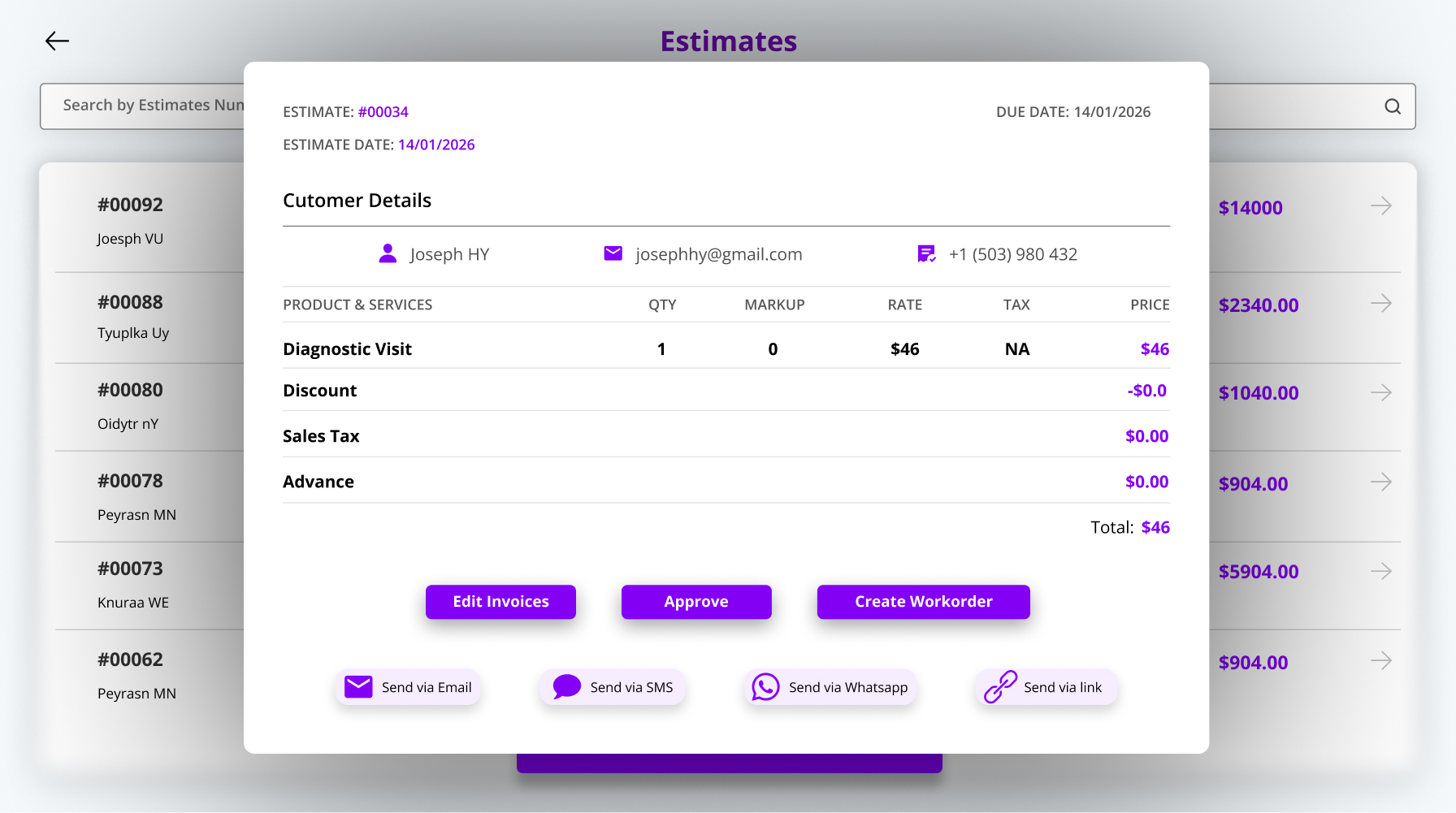
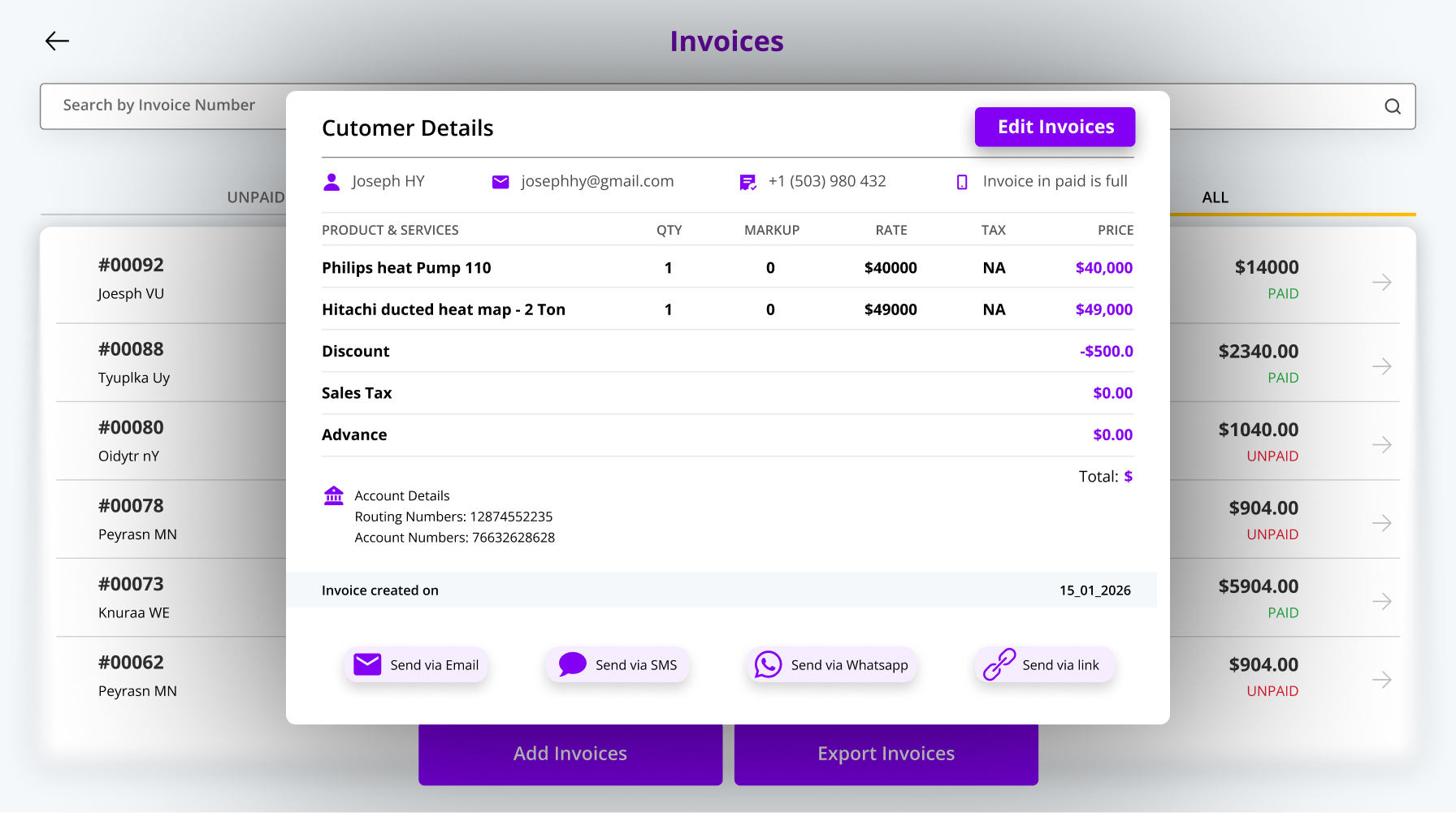
Invoices generate automatically from completed work orders. Payment reminders accelerate collection. Online payment options improve cash flow. Financial reporting reveals profitability by service type, technician, customer segment, and location. Cost tracking enables precise margin analysis. Cash flow improves from faster billing and collection.
/05 Scope
/06 Outcome
Within weeks of going live, something shifted. Dispatchers weren't wrestling with spreadsheets anymore—they were scheduling jobs intelligently, matching technician skills to actual customer needs. Technicians received crystal-clear specifications. No more guessing. No more miscommunication. Managers suddenly had visibility into what was actually happening across their operations. Live visibility. Real-time data. No surprises. Customers got proactive status updates instead of wondering where their technician was. The administrative burden? It didn't just decrease noticeably. It transformed entirely.
Here's where it got interesting. Manual administrative hours—the ones that used to devour time like a black hole—decreased dramatically as automation quietly replaced those endless spreadsheets. Scheduling errors simply vanished. Double-bookings became impossible. Technician idle time plummeted through intelligent route planning that actually made geographical sense. Job completion rates climbed. Response times accelerated. Customers noticed these improvements immediately. They felt it. Experienced it directly.
Money stopped disappearing into operational fog. Billing cycles compressed. Payment collection accelerated noticeably. Cash flow improved in ways finance directors could actually measure. Suddenly—and this mattered enormously—you could see which services generated genuine margin and which ones didn't. Cost analysis identified waste you never knew existed. Financial visibility enabled strategic pricing decisions based on evidence rather than assumption. Profitability improved from multiple directions simultaneously. It wasn't just one thing. It was everything improving at once.
Status transparency built customer confidence in ways traditional service delivery never could. Faster response times improved satisfaction substantially. Professional communication—consistent, reliable, clear—enhanced relationships across the board. Maintenance reminders demonstrated genuine care rather than feeling automated (even though they were). No-show rates decreased from appointment reminders because, honestly, customers appreciated being reminded. Customer retention improved. Referrals increased from genuinely satisfied customers recommending you to friends and family. That's the kind of growth that matters.
Leadership decisions stopped relying on gut feeling and started relying on evidence. Technician productivity metrics revealed genuine capability and highlighted training needs. Customer satisfaction data guided service improvements in ways that actually mattered. Profitability analysis identified high-margin opportunities hiding within operational complexity. Operational metrics revealed bottlenecks—and suddenly you could fix them systematically rather than discovering them through crisis. Strategic planning shifted from guesswork to intelligence. From assumption to evidence. From hoping it worked to knowing it worked.
Growing customer bases no longer demanded proportional staff growth. Automation handled volume increases without watching efficiency degrade. Operational standards remained consistent during expansion—you could scale without losing quality. Technology prevented the capability constraints that typically strangle growth. Expansion became sustainable. Profitable. Achievable without hiring endlessly. You could grow intelligently, confidently, knowing the system would support you rather than collapse under pressure.
/07 Payoff
Automation doesn't just eliminate manual tasks; it fundamentally rewires how work happens. Streamlined processes have removed friction that nobody even noticed was there. Intelligent scheduling has maximised technician utilisation, so people spend time working rather than waiting. Real-time visibility has stopped miscommunication cold. System integration? It has deleted those frustrating duplicate data entry tasks that used to waste everyone's time.
Intelligent algorithms have matched technician skills to actual job requirements, not guesses or memory. Route optimisation has prevented those inefficient dispatching decisions that waste time and fuel. Real-time visibility has made double-bookings impossible because the system sees availability instantly. Automation has eliminated the manual coordination mistakes that human schedulers inevitably make. Error rates haven't just decreased. They nearly vanished.
Route planning isn't random anymore, it's intelligent. Geographic clustering has prevented technicians from wasting hours in unnecessary drive time. Intelligent scheduling has kept people productive rather than waiting for the next job. Real-time visibility means job assignments are happening immediately and preventing gaps between appointments. Suddenly, technicians are spending their day actually working rather than driving aimlessly.
Clear job specifications have prevented the miscommunication that created callbacks. Technician-to-skill matching has ensured the right person shows up with the right capability. Inventory accessibility means materials are available when needed, preventing delays and frustration. Preparation is thorough. Success has become predictable rather than hoped-for.
Operational efficiency improvements have reduced costs substantially. Revenue growth has emerged naturally from capacity expansion and improved customer retention. Profitability analysis has revealed which services actually generated genuine margin. Technology investment has recovered quickly; you don't need to wait years for payback. Your investment has paid for itself faster than expected.
Improved efficiency has enabled more jobs daily without hiring proportionally. Customer retention has reduced acquisition costs considerably. Service upsells have increased because maintenance reminders are prompting customers to book additional work. Pricing optimisation based on actual profitability data has increased margins. Revenue has climbed from multiple directions simultaneously.
Administrative automation has slashed overhead dramatically. Route optimisation has decreased fuel costs noticeably. Inventory management has reduced waste that bled money. Faster billing has improved cash flow. Customer retention has reduced the expensive process of constantly acquiring new customers. Costs haven't just decreased—they have compressed.
Automated invoicing has eliminated delays that used to stretch payments out indefinitely. Payment reminders have accelerated collection substantially. Online payment options have improved convenience and encouraged faster payment. Payment tracking has maintained visibility into who owed what. Cash arrives sooner. Significantly sooner.
Automated invoicing has eliminated delays that used to stretch payments out indefinitely. Payment reminders have accelerated collection substantially. Online payment options have improved convenience and encouraged faster payment. Payment tracking has maintained visibility into who owed what. Cash arrives sooner. Significantly sooner.
Enhanced service delivery has built confidence that you'll show up and do the work properly. Automated maintenance reminders have demonstrated genuine care; customers have felt looked after. Transparent communication has built trust. Consistency has built loyalty. Lifetime customer value hasn't just increased, it has multiplied substantially.
Real-time status updates have provided transparency that customers genuinely appreciated. Faster response times have improved experience because people weren't left wondering. Professional communication—consistent, reliable, intelligent—has enhanced how customers perceive you. Maintenance reminders have demonstrated proactive care. Follow-up communication has ensured satisfaction; it isn't assumed, it's verified.
Cloud infrastructure has grown without requiring hardware investment that traditional systems demand. Automation handles volume has increased without watching efficiency degrade. Operational standards have maintained consistency during expansion—you don't sacrifice quality for growth. Technology has prevented the capability constraints that typically strangle businesses. Scaling has become achievable, sustainable, profitable.
Automation has freed capacity for more jobs without hiring endlessly. Improved efficiency has enabled more service delivery from existing teams. Customer retention has reduced growth friction because you're not constantly replacing departing customers. Operational visibility has prevented scaling problems before they occur. Profitability has improved during expansion rather than getting squeezed. Growth hasn't just happened; it has compounded.
Real-time dashboards have provided operational visibility, replacing gut feeling. Profitability analysis by service has guided strategy with evidence rather than assumptions. Technician performance metrics have guided management decisions meaningfully. Customer satisfaction data has guided improvements toward what actually matters. Evidence has replaced intuition. Strategy has become intelligent.
Superior customer experience from technology investment has differentiated you fundamentally. Operational excellence has enabled better pricing without sacrificing quality. Faster response times have exceeded competition noticeably. Technology leadership has attracted talented technicians who want to work with modern systems. Competition can't match what you've built.
Clear job specifications have reduced technician frustration that created burnout. Route optimisation has reduced drive time, which nobody enjoyed anyway. Mobile access has empowered technicians by giving them information instantly. Performance visibility has recognised capability rather than assuming everyone is equal.
/08 Wrap-up
At Vyrazu Labs, we transform HVAC operational challenges into scalable growth opportunities. HVAC software revolutionises service operations by replacing manual chaos with intelligent automation. Unified cloud platforms consolidate fragmented systems. Intelligent scheduling eliminates double bookings and idle time. Real-time visibility replaces guesswork with operational insight. Automated communication builds customer loyalty systematically. Centralised inventory reduces waste. Intelligent billing accelerates cash flow. By blending machine intelligence with human expertise, we empower service companies to scale profitably, serve customers excellently, and make data-driven decisions. The result: sustainable competitive advantage and thriving enterprises.
/9 Client testimonials
Vyrazu built an AI agent that handles our entire supplier negotiation workflow. What took a team of 6 analysts now runs overnight, autonomously, with better outcomes than we achieved manually.
Their LLM-assisted migration tool cut our 18-month COBOL replatform to 11 weeks. The AI-generated tests caught edge cases our engineers hadn't even thought of. Genuinely impressive engineering.
The RAG pipeline they built pulls from 40,000 internal documents in milliseconds. Our support team now resolves tickets 3× faster and customer satisfaction scores have jumped 28 points.
We came in sceptical about AI agents in production. Vyrazu's reliability engineering approach — guardrails, observability, fallbacks — gave us the confidence to go live. Zero incidents in 8 months.
Their fraud detection model now catches 99.7% of fraudulent transactions at 2M+ per day. It paid back its entire development cost within the first 6 weeks of going live.
Vyrazu treats AI ROI as a first-class requirement. Every model ships with a business metric attached — cost saved, decisions automated, revenue influenced. That discipline is rare and exactly what we needed.
/10 Get in touch
